Reflections, Ideas, Exhortations
This is the first post on my new blog. I’m just getting this new blog going, so stay tuned for more. Subscribe below to get notified when I post new updates.
This is the first post on my new blog. I’m just getting this new blog going, so stay tuned for more. Subscribe below to get notified when I post new updates.
I work on ending homelessness in Concord, NH. Why? Because it gives meaning to my life. Working on this issue is a privilege. It is a gift really. Victor Frankl asserted that the key to surviving Auschwitz was having something yet to do with his life–something that gave his life meaning. This work on homelessness gives my life meaning.
For me, homelessness work is part purpose and part method. The purpose of my homeless work is to love, to care for people in my community. To do what I can during my turn on this earth. Some might call it building the Beloved Community.
In any endeavor, we have to use smart methods to be successful. You can kick a dog to get it to move, but it’s not a very smart way to train a dog. The methods I have found most helpful is a suite of ideas called ProSocial.
I use ProSocial ideas of conscious evolution, governing a commons and mindful action to evolve our community forward, consciously evolve our community systems to end homelessness…a community ever more aligned with my values.
As of January 31 of this year, there are an estimated 521 homeless persons in Merrimack County, plus a mind-boggling 116 homeless students enrolled in Concord schools. Some homeless persons couch surf with relatives or friends. Some live in the rough–a difficult proposition in these winter months, Some sleep in a shelter and mark time, mostly outdoors, during the day. Others live in their cars. Some panhandle at traffic stops. Some work full time jobs. Some are working their way back from domestic violence or economic crisis or addiction. Others seem to be stuck in self-destruction or despair.
Residents in my ward, the South End of Concord, are worried about walking in the woods with their kids safely where homeless persons live. Some people are having their propane tanks stolen. The city spends taxpayer dollars to clean up campsites littered with plastic and propane tanks and needles–it cost $40,000 to clean up one site last year. Some businesses think their customers are put off by panhandlers.
Homelessness is a complex wicked problem that no one solution will address. But many agencies work on solutions. Family Promise, which we and other faith communities support, has one approach. The Friends Family Emergency Shelter has another. Waypoint works with youth. Concord Coalition to End Homelessness runs a day-time, winter shelter for adults and a resource center. CATCH builds affordable housing. The Belknap-Merrimack Community Action Program does street outreach. Christ the King Parish runs a services fair and a food pantry. All are experts in what they do, like master musicians. But I wouldn’t call this work a symphony.
What is a symphony without a score, without a conductor? We wouldn’t have it. Noone would want to listen. A system is a collection of actions or agents with a common aim. There is, currently, no common aim concerning homelessness. There is insufficient, effective coordination. Faith communities doing their thing. Nonprofits doing their thing. Government departments acting within their scope. There is neither a score nor a conductor for our community’s work to end homelessness.
I am reminded of the story about two stone cutters. You ask one what are you doing and he responds “I’m cutting stone.” You ask the other what are you doing and he answers “I’m building a cathedral.”
I don’t do advocacy. Advocacy does not solve complex wicked problems. I am not an advocate. I am a learner. As a community we need to be all in–all the agencies and departments and faith communities. Each according to their role, each according to their resources. Working together, coordinated, accountable, learning together. We have to evolve our way to a solution. We have to try stuff, discard the stuff that doesn’t work and build on the things that seem to work. We have to learn our way forward. I am working so that our community can mindfully act ever more aligned with our values–respect, fairness, dignity, a home for all.
For me this is not simply social justice work. It’s more than social justice. It’s also about safety and dignity and fairness for all. Homeowners and renters and homeless persons alike. Justice is important. So are other values. For me it’s not about what is right or just, it’s about what is possible. What is possible to build in our community. What is possible to create together, aligned with our values. All in. Together. Nothing less will do. I’m still learning. Join me. Learn with me. I need all the help I can get.
Prosocial (Prosocial: Using Evolutionary Science to Build Productive, Equitable and Collaborative Groups by Atkins, Wilson and Hayes) is a mix of ideas from evolutionary science, core design principles for governing a commons from Elinor Ostrom, and Acceptance Commitment Therapy (ACT)(Training) based in contextual behavioral science.
Here in Concord, there are more than 60 agencies and departments that are working on or touch the issue of homelessness. All are working hard, doing good work…and not well aligned nor coordinated. Concord Coalition to End Homelessness is a great agency, but we cannot solve the problem on our own. It is truly a wicked problem (even if modest compared to some of the larger cities in the country). So the challenge is to help these agencies and departments evolve from an agency focus to a community-wide aim to achieve functional zero. Multi-level selection theory from evolutionary science gives some scientifically grounded ideas of how we might go about that, because human history is a series of evolutionary steps of small groups learning to work together in larger and larger groups to address their environmental challenges. Ostrom’s Nobel prize winning research on governing commons provides design principles that guide managing a common endeavor without government or corporate control. And ACT injects simple, yet powerful mindfulness techniques to build group psychological flexibility to loosen rigid beliefs and behaviors and strengthen the ability, over time, to act ever more aligned with chosen values. (See also Prosocial.World.)
What is current performance of the Concord Housing (In)Stability System?
The performance of the Concord Housing (In)Stability System can be described in a number of ways–outcomes for the beneficiaries of a system, effectiveness (user benefit), efficiency (ratio of output to inputs), stakeholder satisfaction, etc.
The numbers are difficult to come by. And every estimate comes with caveats–measurement errors and vaguely defined variables.
The annual Point In Time (PIT) count notoriously inaccurate. But annual data for New Hampshire as a whole show a pretty flat line since 2010.
Data can also be retrieved from the NH Homeless Management Information System (HMIS) run by the state Bureau of Housing Supports, specifically the Coordinated Entry (CE) Program which can allow a person to be entered into the regional queue for housing vouchers and other services (e.g. rapid rehousing, supportive housing, etc.). The CE numbers are challenged by data entry (getting homeless persons assessed and entered into the system) and data accuracy (removing person who have moved, died, found housing, etc.) issues. Nonetheless, CE enrolled figures suggest between 200-300 currently homeless persons in Concord and Merrimack County. Plus more living in hotels and other temporary accommodations.
What about other measures of system performance?
Possible measures include:
Why is ending homelessness in our community an example of a commons?
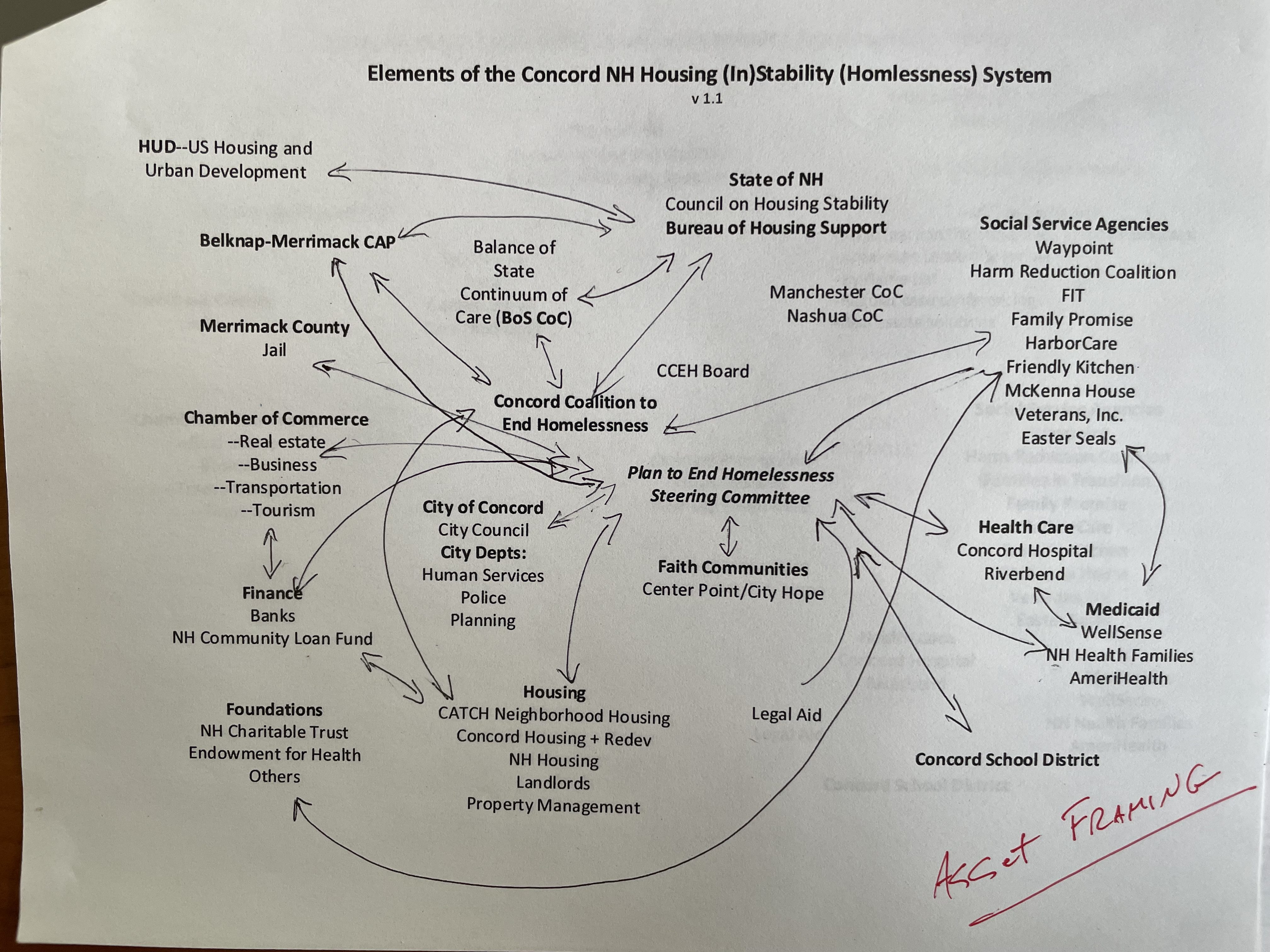
There are many agencies, institutions and government departments in the Concord, NH community working on some facet of the prevention, service and resolution of homelessness.
The diagram shows numerous purpose-driven groups working hard on one or more parts of the system–social services, public safety, mental health, housing, financing–you get the picture. It’s complex.
It’s complex and it is actually a system, with inputs, outcomes and flows between and among the different players. We might call in the Concord NH Housing (In)Stability System–the system that causes and responds to homelessness in our area. This system has real life impact for persons at risk of or experiencing homelessness and the myriad workers, volunteers and citizens who contribute in one way or another to the system.
What is a commons?
From medieval times, commons referred to any resource used together with others–grazing land, forests, water use. From modern times it has been described as any common pool natural resource, such as fishing rights, irrigation, pastures. The “tragedy of the commons” as described by Garrett Hardin in 1968 is that if not well managed, commons will be overused, depleted, perhaps destroyed.
What are the ways to govern a commons?
This traditional understanding of management or commons required either government or private control. Rule making and compliance is their responsibility. In the 1970’s, Nobel laureate Elinor Ostrom studied diverse common-pool resources groups around the globe. She demonstrated that humans can cooperate around shared resources under certain conditions (Ostrom’s Cored Design Principles) and successfully avoid the “Tragedy of the Commons.” These core design principles, if adapted to specific contexts predicted successful management of the shared resource.
Core Design Principles

So these core design principles (CDPs) apply to natural resources?
Yes, but there’s more. David Sloan Wilson, noted evolutionary biologist, worked with Ostrom to generalize the CDPs to any commons, any common purpose or resource that needs collective trust and collaboration. Examples might include creating sustainable energy use, regional actions to reduce groundwater pollution, reducing violence in our communities, promoting equitable healthcare access, etc.
What might be some examples of commons in central New Hampshire (capital area)?
I can think of a few examples:
And my interest–
Improvement science has guided my health improvement work for more than three decades. Deming’s definition of a system includes the critical understanding that a system’s outputs (results) are a function of the attributes of the system itself–“Every system is perfectly designed to give the results it gets.” (Outcomes, the impact or import of outputs for the beneficiaries (customers) of a system, connects the systems to a specific context–specific beneficiaries.)
Recently, evolution science has intrigued me as an even more powerful frame to understand the history of (social, cultural, technical) systems change and the current opportunities to accelerate change ever more aligned with our values (improvement).
David Sloan Wilson has been perhaps the leading advocate for this (evolutionary) view of life–to paraphrase Darwin. Wilson’s key insights, for me, are three-fold:
3. Multilevel selection–evolution occurs at multiple levels at the same time. Individuals are typically also members of groups and selection occurs at both the individual level and at the group level. But groups are also, typically parts of larger groups. So selection occurs in groups of groups. Often there is a trade-off between the individual benefit and the group benefit. Individuals may have to forego certain benefits for the “good of the group.” (My example is a basketball team. Not everyone can (or needs to) be the highest scorer. But by developing differentiated roles, players can develop behaviors that provide a winning formula for the team. )
“Selfishness beats altruism within groups. Altruistic groups beat selfish groups. Everything else is commentary.” (Wilson and Wilson 2007)
It’s evolution all the way up and down.
David Sloan Wilson, Paul Atkins and Steven Hayes have integrated this evolutionary view of life with Elinor Ostrom’s core design principles for managing a commons and Acceptance, Commitment Therapy (or Training in a non-therapeutic context).
More later…
To improve a system, it may be helpful to frame three components of that system: 1) how we make what the system provides, 2) what society needs, and 3) how we improve what we make in the system.
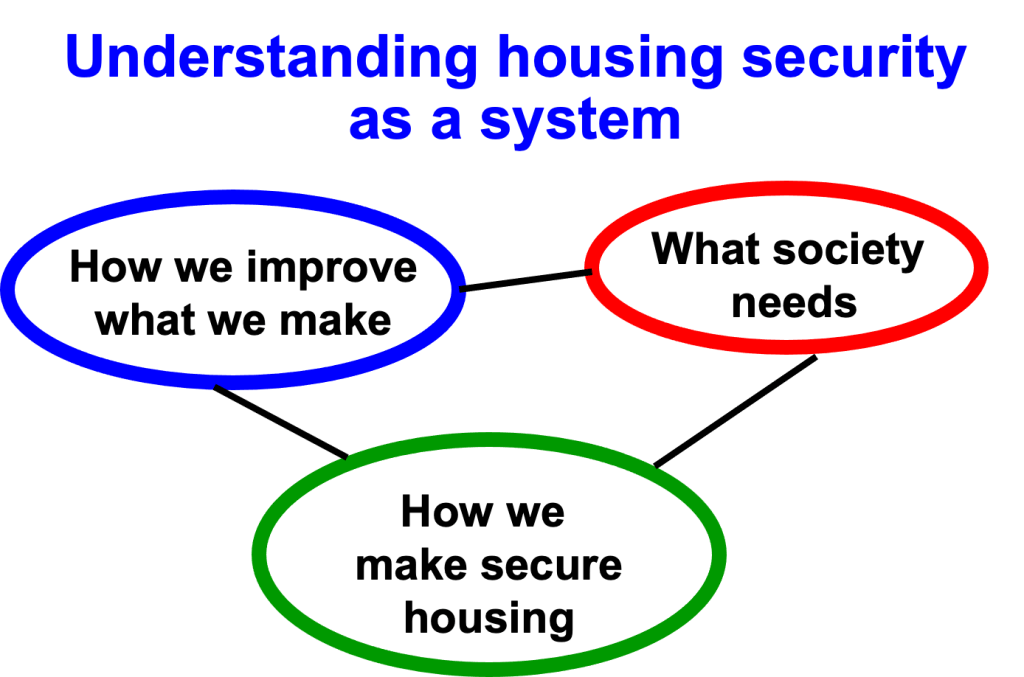
A system is an interdependent group of people, items, process, products and services that have a common aim (from Deming). One way to frame a common aim of the (very complex) housing security system in Concord, NH is: To insure secure housing for all. To be able to improve this system, we need to link this aim with the “production” system and a commitment to continually improve.

What does the housing security system make (the outputs of our system)? There are two main process groups of the “production” system–a housing system which provides access to homes to rent or buy, and the homeless services processes for those persons who have lost access to housing. These two main production processes are linked to other subsystems that impact housing security, such as health services, employment and other social and education services. We will discuss the inputs and suppliers for these processes at another juncture. The customers or beneficiaries of this production system are persons in our community with secure housing.

Secure housing is created because there is a social need. This need for stable and safe housing allows people to be productive, happy residents of our community. Customer or beneficiary knowledge of how well the housing system is meeting (or not meeting) the needs of area residents, in relation to the social and community need for secure housing, can guide the efforts to make the system better.
Improvement starts with the current state of the social production system, linked to the community and social need, and is guided by our collective mission and vision for a securely housed community.
Homelessness in New Hampshire is modest–it does not affect millions, yet it does effect thousands of individuals and families across the state. In one region, such as Merrimack County, the numbers are much less, in the hundreds. And folks who are chronically homeless (e.g. greater than one year with a disability) are even less. Homelessness is solvable as evidenced by the successes in engaged communities across the US. So let’s posit our mission and vision (aim) is to end homelessness–zero homeless persons. Or to be precise–functional zero: the number of persons becoming homeless in a given month is equal or less than the number of persons we can predictably house within 30 days (typically measured in meaningful subgroups, e.g. chronic, youth, families, etc.).
A community has ended chronic homelessness when the number of people experiencing chronic homelessness is zero, or if not zero, than either 3 or .1% of the total number of individuals reported in the most recent point-in-time count, whichever is greater.
See Functional Zero
Once we understand the current state of our housing security system, appreciate the social need and agree on a clear vision of the future we want to create, we can create a plan to improve this system with input from the knowledge of beneficiaries of the system (what is meeting their needs and what is not). To be helpful the plan needs to be concrete–specific goals, with metrics and time frames. Given a plan to improve with a set of measures, we can begin to identify specific parts of the system that if changed (redesigned) we predict will lead to better outcomes. Also we may identify new system elements that need to be created (designed). Design and redesign targets specific elements of the current system (steps in the housing and homelessness service systems).
This work of executing a plan to improve the housing security system with specific targets of design and redesign is best approached from a learning frame. Using a model for improvement allows us to test (often initially on a small scale) our ideas of what we predict may be helpful.

From tests of change ideas (PDSA: Plan a test of the change, Do the test, Study the results, and Act to adopt, modify or abandon the idea) we can learn what works (and why) and what does not work. We can adopt the successful changes and modify or abandon the unsuccessful change ideas. With collaboration and disciplined execution of an improvement plan we steward a learning housing security system that is continually improving–relentless incrementalism!
Briefly, see Don Berwick’s 2021 National Forum Plenary on Ten Teams: Health Care’s Great Power and Great Responsibility He starts with a previous framing of the Moral Determinants of Health which include Ending hunger and homelessness in the US. His frame is that the healthcare system must become an active agent of change. He challenges every hospital and health system to create ten teams, each linked to key causes of ill health and disease not just to do good, but because these social determinants are core to their missions. He calls for engagement beyond the usual Community Benefit Program, to include a central daily strategic focus of the organization’s Board, senior executives, finance leaders, and accountability systems on the core systems that drive health and well-being. Why? Because healthcare is too big. It takes too much of the GDP (19.7% as of 2020) to stand on the sidelines.
For each team he suggests an aim, the connection to health, experts available for guidance and advice, and one or more exemplary organizations that have tackled the issue successfully. The teams should include:
One of these ten teams should be on Housing Security. Berwick calls out Rosanne Haggerty and the exemplary work of Community Solutions which this year won the $100m McArthur Foundation challenge grant to accelerate an end homelessness in America. Hospitals are challenged to commit to end chronic homelessness in the region served by the hospital and join the “Built for Zero” movement. Not every organization will have the scale to stand up all ten teams. As a simple heuristic, he suggests that a hospital stand up one team for every $100m in revenue. As an example, Concord (NH) Hospital had $555m in revenue in 2020 and thus might be challenged to charter five teams, one of which we propose would have a focus on housing security.
“Every system is perfectly designed to give the results it gets.”
Context: Social determinants drive 80% of health outcomes, clinical care drives 20% (see County Health Rankings Model).
Food insecurity, unemployment, and poverty increased during the great recession (2008) and was exacerbated by the COVID-19 pandemic. Yet SNAP (Supplemental Nutritional Assistance Program–food stamp) enrollments have not increased.
NH is some of the lowest participation in the US for federal food programs (36th in SNAP, 47th in school breakfasts, 32nd in Child and Adult Food Programs, etc.). (Extra credit question: Why is this?)
It is estimated that $1 in SNAP generates $1.50 in economic benefits.
Senior food bank executive in NH: ” We have low enrollment because people are embarrassed to apply.”
But doe this imply that New Hampshire’s 36th in the country enrollment ranking is caused by excess “embarrassment” about applying for food stamps in NH?
How easy is it to apply for food stamps–if you do or do not have internet access?
++++++++++++++++++++++++++++++++++++++++++++++++++++++++++
Before You Start the Application
You may need the following information for each person in the household to help you complete this application. You should try to gather as much of it as possible before you start. It may take 20-45 minutes to complete your application, depending on the number of people in the household.
+++++++++++++++++++++++++++++++++++++++++++++++++++++++++++
Actions (focused on SNAP):
Lingering Questions
What questions or insights do you have about the NH food stamp system?


 NH Collective Health Impact