To improve a system, it may be helpful to frame three components of that system: 1) how we make what the system provides, 2) what society needs, and 3) how we improve what we make in the system.
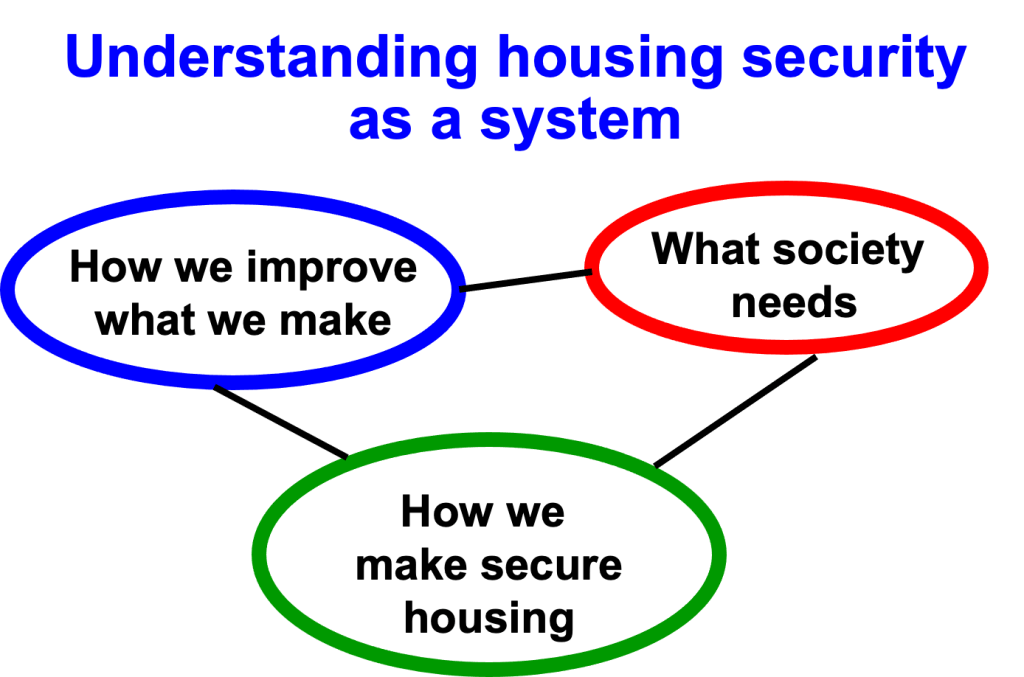
A system is an interdependent group of people, items, process, products and services that have a common aim (from Deming). One way to frame a common aim of the (very complex) housing security system in Concord, NH is: To insure secure housing for all. To be able to improve this system, we need to link this aim with the “production” system and a commitment to continually improve.

How do we make what we make?
What does the housing security system make (the outputs of our system)? There are two main process groups of the “production” system–a housing system which provides access to homes to rent or buy, and the homeless services processes for those persons who have lost access to housing. These two main production processes are linked to other subsystems that impact housing security, such as health services, employment and other social and education services. We will discuss the inputs and suppliers for these processes at another juncture. The customers or beneficiaries of this production system are persons in our community with secure housing.

Why do we make what we make?
Secure housing is created because there is a social need. This need for stable and safe housing allows people to be productive, happy residents of our community. Customer or beneficiary knowledge of how well the housing system is meeting (or not meeting) the needs of area residents, in relation to the social and community need for secure housing, can guide the efforts to make the system better.
How do we improve what we make (in the housing security system)?
Improvement starts with the current state of the social production system, linked to the community and social need, and is guided by our collective mission and vision for a securely housed community.
Homelessness in New Hampshire is modest–it does not affect millions, yet it does effect thousands of individuals and families across the state. In one region, such as Merrimack County, the numbers are much less, in the hundreds. And folks who are chronically homeless (e.g. greater than one year with a disability) are even less. Homelessness is solvable as evidenced by the successes in engaged communities across the US. So let’s posit our mission and vision (aim) is to end homelessness–zero homeless persons. Or to be precise–functional zero: the number of persons becoming homeless in a given month is equal or less than the number of persons we can predictably house within 30 days (typically measured in meaningful subgroups, e.g. chronic, youth, families, etc.).
A community has ended chronic homelessness when the number of people experiencing chronic homelessness is zero, or if not zero, than either 3 or .1% of the total number of individuals reported in the most recent point-in-time count, whichever is greater.
See Functional Zero
Once we understand the current state of our housing security system, appreciate the social need and agree on a clear vision of the future we want to create, we can create a plan to improve this system with input from the knowledge of beneficiaries of the system (what is meeting their needs and what is not). To be helpful the plan needs to be concrete–specific goals, with metrics and time frames. Given a plan to improve with a set of measures, we can begin to identify specific parts of the system that if changed (redesigned) we predict will lead to better outcomes. Also we may identify new system elements that need to be created (designed). Design and redesign targets specific elements of the current system (steps in the housing and homelessness service systems).
This work of executing a plan to improve the housing security system with specific targets of design and redesign is best approached from a learning frame. Using a model for improvement allows us to test (often initially on a small scale) our ideas of what we predict may be helpful.

From tests of change ideas (PDSA: Plan a test of the change, Do the test, Study the results, and Act to adopt, modify or abandon the idea) we can learn what works (and why) and what does not work. We can adopt the successful changes and modify or abandon the unsuccessful change ideas. With collaboration and disciplined execution of an improvement plan we steward a learning housing security system that is continually improving–relentless incrementalism!
 NH Collective Health Impact